


Research Involving Children
Children are considered a vulnerable population under federal regulations. Research involving children must meet additional requirements under 45 CFR 46 Subpart D. If you plan to enroll children in your study, these rules apply to your protocol.
Children are considered a vulnerable population under federal regulations. Research involving children must meet additional requirements under 45 CFR 46 Subpart D. If you plan to enroll children in your study, these rules apply to your protocol.
Who Is Considered a “Child”?
Under federal regulations, a child is:
A person who has not reached the legal age to consent to the treatments or procedures involved in the research, under the law where the research is conducted.
In most U.S. states, the age of majority is 18, but laws vary.
Important:
- Some minors may legally consent to certain treatments in some states.
- A legally emancipated minor may be considered an adult.
- You must consult OHSRP before enrolling a minor as an adult or determining that a minor is emancipated.
What Additional Rules Apply?
When reviewing research involving children, the IRB must apply special protections. Approval depends on:
- Whether the child is healthy or has (or is at risk for) the condition under study
- Whether the research is minimal risk or greater than minimal risk
- Whether the research offers the prospect of direct benefit to the child
Your protocol must clearly describe:
- What procedures children will undergo
- Which procedures apply to which groups (for example, healthy controls vs. affected children)
Using a table can help clarify this for IRB review.
What is "Minimal Risk"?
Minimal risk means:
The risk is no greater than what a child would experience in daily life or during routine medical or psychological tests.
Examples may include:
- Small blood draws
- Non-invasive specimen collection (urine, saliva)
- Non-contrast MRI without sedation
If you are unsure whether a procedure is minimal risk, contact the IRB Office.
Types of Research Involving Children
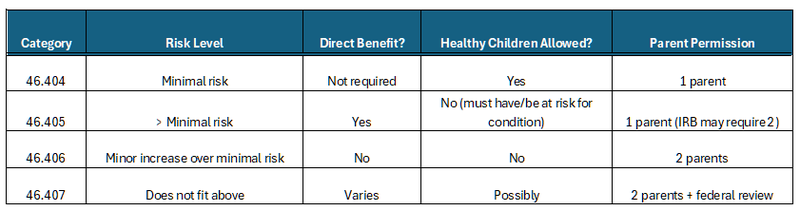
Federal regulations group research into four categories:
- No greater than minimal risk
- May include healthy or affected children
- Requires assent (when appropriate) and permission from one parent
Examples: surveys, chart review, non-contrast MRI
- More than minimal risk
- Must offer the prospect of direct benefit to the child
- Risk must be justified by the expected benefit
- Requires assent (when appropriate) and permission from one parent
- The IRB may require permission from two parents
Example: investigational drug for a child’s condition
Important: The benefit must come from the same procedure that carries the risk. Risks cannot be justified by benefits from unrelated procedures.
- More than minimal risk
- Only a minor increase over minimal risk
- No direct benefit to the child
- Must provide important knowledge about the child’s disorder or condition
- May NOT enroll healthy children
- Requires assent (when appropriate) and permission from both parents, unless exceptions apply
Examples: CT scan or MRI with contrast used only for research data
- Does not meet the above categories
- Must address a serious problem affecting children
- Cannot be approved by the IRB alone
- Requires federal-level review and approval
This category is rare.
Parental Permission
In research involving children:
- “Permission” is the regulatory term used instead of consent.
- Unless waived by the IRB, parental permission is required.
How Many Parents Must Sign?
- Minimal risk or direct benefit studies: One parent is usually sufficient.
- Greater than minimal risk without direct benefit: Two parents are required (with limited exceptions).
At NIH sites, if parents share joint legal custody, both parents must give permission unless one parent is deceased, incompetent, not reasonably available, or has sole legal responsibility.
The IRB may waive parental permission in limited circumstances (for example, certain adolescent research), except in FDA-regulated research.
Assent from Children
Assent means the child’s affirmative agreement to participate.
- Silence or lack of objection is not assent.
- The child must actively agree.
Unless waived, assent is required when the child is capable of providing it.
When Can Assent Be Waived?
The IRB may waive assent if:
- The child is not capable of providing assent,
- The research offers important direct benefit available only through the study, or
- The research meets the regulatory criteria for waiver of consent.
The regulations do not require written documentation of assent. The IRB decides whether assent should be:
- Written
- Verbal
- Or documented in another way
The NIH IRB prefers age-appropriate written assent forms when possible.
When a Child Becomes an Adult During the Study
When a participant reaches the legal age of majority (18 at the NIH Clinical Center):
- The participant must provide their own informed consent to continue participation,
- Unless the IRB has approved a waiver of consent.
This applies even if the study only involves ongoing data or specimen analysis and the participant is identifiable.
Research Involving Wards of the State
Special restrictions apply when enrolling children who are wards.
If you plan to enroll wards:
- Contact the IRB Office before submission.
- An independent advocate must be appointed for each child who is a ward (in certain categories of research).
Can Research Involving Children Be Exempt?
Not all exemption categories apply to research involving children.
For example:
- The 2018 exemption for benign behavioral interventions cannot involve children.
Consult the IRB Office before submitting exempt research involving children.
What Must Be Included in Your IRB Submission?
Your protocol must include:
- A justification for including children
- A plan for parental permission
- A plan for obtaining assent
- A justification if requesting a waiver of permission or assent
- Age-appropriate assent materials (if applicable)
Submit:
- Parental permission form(s)
- Written assent form(s), if applicable
Need Help?
Before enrolling children—especially in complex situations (emancipated minors, wards, waiver requests)—consult OHSRP at: irb@od.nih.gov
Related Resources
Research Enrolling Vulnerable Individuals - What Investigators Need to Know
Presented by Peg Sanders, RN, MSN, MA, CIP
Research with Children-An Ethical and IRB Perspective
Presented by Jonathan Green
OHRP Subpart D — Additional Protections for Children Involved as Subjects in Research
FDA Subpart D—Additional Safeguards for Children in Clinical Investigations
OHRP Research with Children FAQs
OHRP Special Protections for Children as Research Subjects
OHRP Children as Research Subjects and the HHS "407" Process